
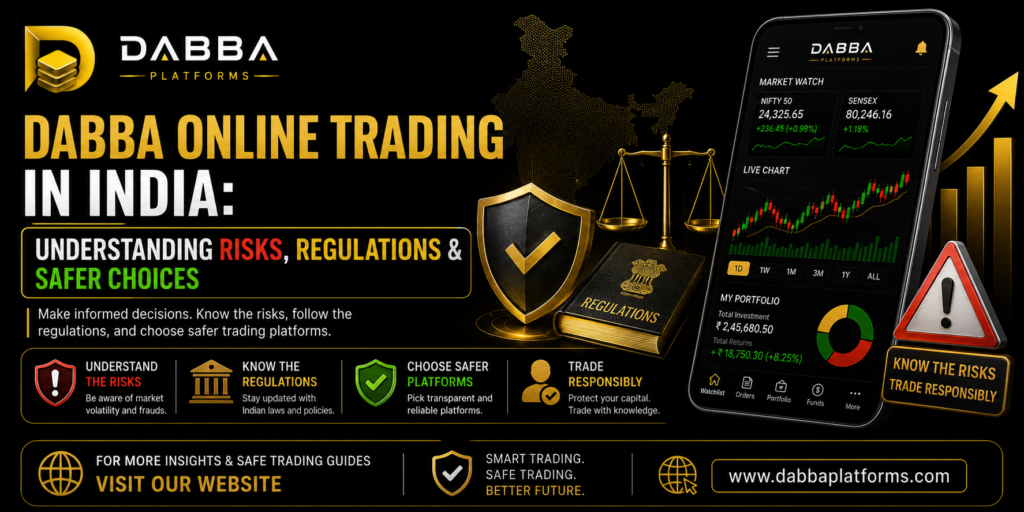
The growing interest in Dabba Online Trading in India reflects the increasing popularity of digital financial services and online market information. As traders search for convenient ways to access market-related opportunities, it is important to understand the difference between regulated trading and unofficial trading arrangements.
Individuals looking for Trusted Dabba Trading in India need to exercise a great deal of caution when it comes to giving out personal details, making payments or engaging in any sort of business transactions. As per SEBI, dabba trading is an unauthorized and unregulated form of trading in securities since no actual transactions take place on the recognized stock exchanges.
This guide is dedicated to educating individuals about such risks.
What is Dabba Online Trading in India?
Featured-Snippet Answer: Dabba trading involves the practice of trading in securities that is not conducted through legitimate stock exchanges. The regulator calls dabba trading an illegal and unregulated practice, and traders don’t have access to the usual exchange-provided systems for dealing with grievances.
While in a regular market, deals are made through legitimate market infrastructures and intermediaries. Dabba trading operates outside this structure, thereby raising more questions regarding investor protection, transparency, dispute resolution, and risk management of counterparties.
Those looking to learn about Dabba Online Trading in India need to start from here.
Why Is Dabba Trading Risky?
Dabba trading can expose participants to risks that may not exist in the same form when dealing through recognized exchanges and regulated intermediaries:
Limited Investor Protection
SEBI states that because dabba trades are not executed on official stock exchange platforms, participants cannot access the stock exchanges’ grievance-redressal mechanisms for those transactions.
This is an important consideration for anyone evaluating a trading service.
Unregulated Operations
A website, application, social media page, or group can be made to look professional without necessarily having the security that would come from a regulated intermediary.
The National Stock Exchange (NSE) advises investors to interact only with intermediaries registered by SEBI and explicitly states that dabba trading is illegal.
Financial Loss
Trading always involves financial risk, but unofficial arrangements can add further uncertainty concerning how trades are recorded, settled, or disputed.
Investors should never assume that attractive returns are guaranteed. SEBI also advises investors not to rely on unregistered intermediaries or promises associated with unsafe trading practices.
What Does Trusted Dabba Trading in India Really Mean?
Answer in a Featured Snippet: If you are searching for Trusted Dabba Trading India, then do not consider the term trusted as proof of legality and regulation of the unregulated trade. The best thing to do would be to check whether the respective intermediary is licensed and if deals are carried out using proper market infrastructure.
Do not trust anything else but facts.
Before using any financial platform, consider the following:
- Is the intermediary properly registered?
- Are the services clearly explained?
- Are risks disclosed?
- Are terms and charges transparent?
- Is customer support accessible?
- Can registration details be independently verified?
- Are transactions conducted through recognized market infrastructure?
These checks can help users make better-informed decisions.
How to Choose a Safer Online Trading Environment
People interested in Dabba Online Trading in India may actually be looking for convenient digital access to financial markets. A safer approach is to research regulated alternatives and understand how legitimate online trading works:
Verify Registration
Before opening an account, independently verify the intermediary’s regulatory credentials. Do not rely solely on registration numbers or claims displayed on a website.
NSE’s investor guidance recommends dealing with SEBI-registered intermediaries.
Check Official Information
Consult credible sources for verification of brokers, intermediaries, investment advisers, and other regulated entities. Do not rely on your decision-making solely on unsolicited communications, social media, or chat groups.
Avoid Guaranteed Returns
No legitimate market participant can guarantee profits regardless of market conditions. NSE investor guidance warns against assured or fixed-return promises and recommends verifying information through official sources.
Protect Your Account
Financial accounts online hold private details. Use secure passwords, activate security settings when possible, and never give out passwords, authentication codes, or other banking details to unknown individuals.
Online Trading and Ethical Trading Practices
Online Trading can make financial-market information and legitimate trading services more accessible. However, digital convenience should not replace due diligence.
A responsible approach involves learning about the relevant financial product, understanding volatility, checking costs, evaluating risk tolerance, and confirming the regulatory position of the service provider.
SEBI’s investor guidance also recommends avoiding unregistered brokers and intermediaries and understanding terms and conditions before entering into agreements.
For beginners, financial education should come before financial commitment.
Key Takeaways
- Dabba Online Trading in India refers to unofficial trading arrangements outside recognized exchange mechanisms.
- SEBI identifies dabba trading as illegal and unregulated.
- Participants may not have access to normal stock-exchange grievance mechanisms.
- Searching for Trusted Dabba Trading in India requires independent verification rather than reliance on marketing claims.
- Investors should consider SEBI-registered intermediaries and recognized market infrastructure.
- Guaranteed-return claims should be treated as a major warning sign.
- Protect passwords, financial information, and account credentials.
- Research and financial education should come before trading decisions.
Final Thoughts:
The quest for dabba trading in India must start with knowledge rather than assumptions. Even though informal dabba trading is marketed as being convenient and profitable, the official guidelines from the Indian investor’s point of view state that it is an illegal and unregulated form of dabba trading.
When you are seeking information on Trusted Dabba Trading in India, trust must emanate from openness, reliable information about regulatory bodies, responsibility, and knowledge on the part of investors—never from guarantees of profit.
Visit Dabba Platforms for educational information about trading platforms and market-related matters.
Frequently Asked Questions
Is Dabba Online Trading in India legal?
SEBI states that dabba trading is an illegal and unregulated form of securities trading. Such trades are not actually executed on official SEBI-recognized stock exchanges.
Can dabba traders use stock exchange grievance mechanisms?
No. SEBI explains that because dabba transactions are not executed on official stock exchange platforms, participants cannot use the exchanges’ grievance-redressal mechanism for those transactions.
How will I get a secure trading platform?
Check the credentials of the intermediary using the regulatory or exchange website, know about their services and fees, read the risk warnings, and do not use any unregistered operator or unrealistically profitable one.
Is Online Trading Risk-free?
No. Trading in the markets is associated with risks. There may be losses due to various reasons.
Should beginners participate in dabba trading?
Beginners should not treat dabba trading as a safe alternative to regulated market participation. The official investor guidance from SEBI and NSE warns against participating in dabba trading.