
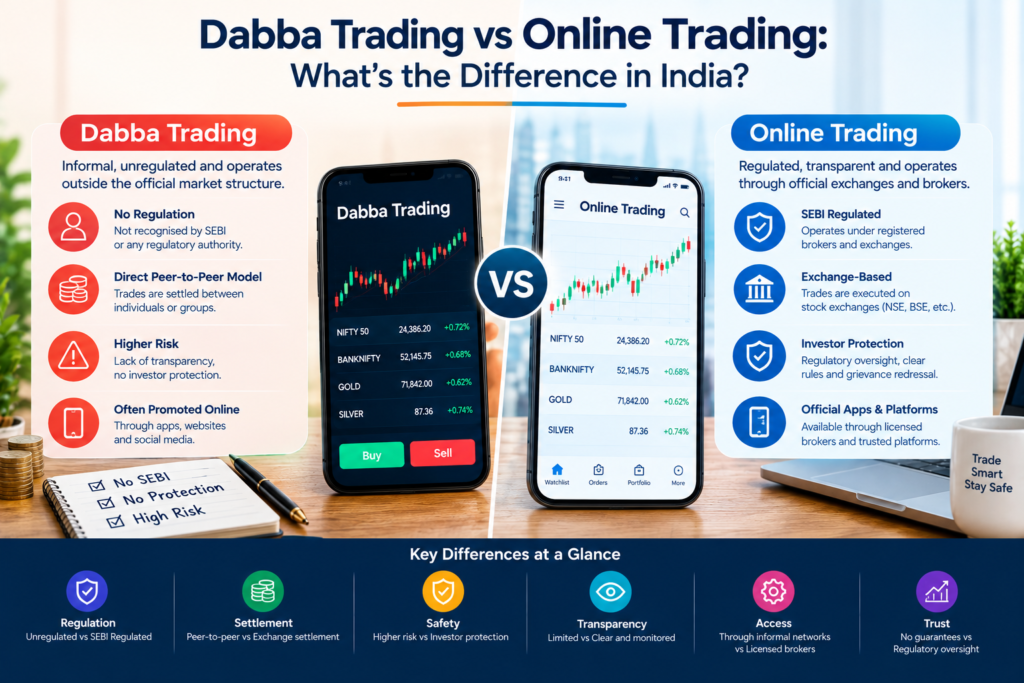
The words “Dabba Trading vs Online Trading” can sound similar because both may be discussed through websites, apps and digital communication. The underlying structures, however, can be very different. Understanding that distinction matters before a person chooses a service, transfers money or assumes that a familiar interface means the same level of protection. This article explains the basic differences in practical terms.
What regulated online trading generally means
Regulated online trading typically connects the user with a recognized intermediary and market infrastructure. Orders are recorded through established systems, transactions are subject to applicable rules and statements provide a formal record of activity. Depending on the product, trades may be cleared and settled through recognized mechanisms.
The user should still understand market risk, fees and leverage, but the framework provides defined processes for records, supervision and complaints. These structural protections are an important part of the service, not merely a feature of an app.
What dabba trading refers to
The term dabba trading is commonly used for arrangements in which transactions are kept outside the official exchange trading and settlement system. Instead of a trade being executed and settled through recognized infrastructure, the operator and customer may settle gains and losses privately.
Because the transaction is outside the normal regulated process, users may face additional risks involving counterparty reliability, record keeping, withdrawals and dispute resolution. The exact arrangement can vary, so claims should be evaluated carefully rather than assumed from a website’s branding.
Why the difference matters
Two websites may show almost identical charts and order buttons while offering completely different legal and operational structures. A customer may therefore believe they are accessing a normal market when the actual arrangement is private and unregulated.
The first question should be where the order goes. The second is how it is recorded and settled. The third is which regulator and formal complaint process apply. These questions reveal much more than an attractive dashboard or a promise of high returns.
Margin and leverage comparison
Unregulated services sometimes attract attention by promoting unusually high leverage or flexible margin arrangements. High exposure can magnify both gains and losses. It may also increase the possibility that a small market movement creates a large liability relative to the user’s deposit.
In any leveraged environment, users should understand position size, margin calls, liquidation or square-off rules and all charges. The absence of a conventional market structure can add another layer of risk because the counterparty relationship may be less transparent.
Records, withdrawals and dispute handling
In a regulated environment, transaction records and account statements are part of the formal process. Users can generally identify the relevant intermediary and understand how complaints are escalated. With an informal arrangement, the customer may depend more heavily on the operator’s own records and willingness to honor settlements.
Before sending money, ask how withdrawals work, whose account receives the funds, what documentation is provided and what happens if there is a disagreement. A vague answer is a reason to pause.
How to evaluate online claims
Promotional websites often highlight speed, margin or profit examples. These claims should not be treated as evidence of legitimacy. Users should independently verify regulatory information and the legal identity of the operator.
Search results and social posts can also be misleading because testimonials may not represent typical outcomes. A responsible decision requires primary documentation and a clear understanding of the actual transaction flow.
Choosing with risk in mind
If the objective is to participate in recognized markets, the legal and settlement framework should be a central part of the selection process. Users should compare services on transparency, regulation, security, fees and customer support rather than only on leverage or promotional language.
Anyone searching for dabba trading in india should first understand that convenience and market access are not the same as investor protection.
Conclusion
The biggest difference between conventional online trading and dabba arrangements is not the device used to place an order. It is the underlying execution, recording, settlement and regulatory structure. Understanding this difference can help users avoid confusing a professional-looking interface with a regulated financial service.
Before committing money, verify the operator, read the terms and understand exactly how every trade is handled.
Keyword note: Readers comparing services should research dabba trading platform carefully, verify the operator’s identity and understand how orders, records, settlement and withdrawals are handled.
Keyword note: Readers comparing services should research dabba trading platform carefully, verify the operator’s identity and understand how orders, records, settlement and withdrawals are handled.
Keyword note: Readers comparing services should research dabba trading in india carefully, verify the operator’s identity and understand how orders, records, settlement and withdrawals are handled.
Keyword note: Readers comparing services should Research Dabba Trading App carefully, verify the operator’s identity and understand how orders, records, settlement and withdrawals are handled.
How to compare services objectively
Create a simple comparison sheet with columns for operator identity, regulatory status, execution, settlement, margin, fees, security, withdrawals and support. Score only information that can be verified. Leave unknown fields blank rather than giving an assumption a positive score.
This approach reduces the influence of promotional language and makes it easier to explain a decision later. It also highlights when a service is asking customers to accept too much uncertainty.
Reliability is demonstrated through verifiable information, consistent processes and clear accountability.