
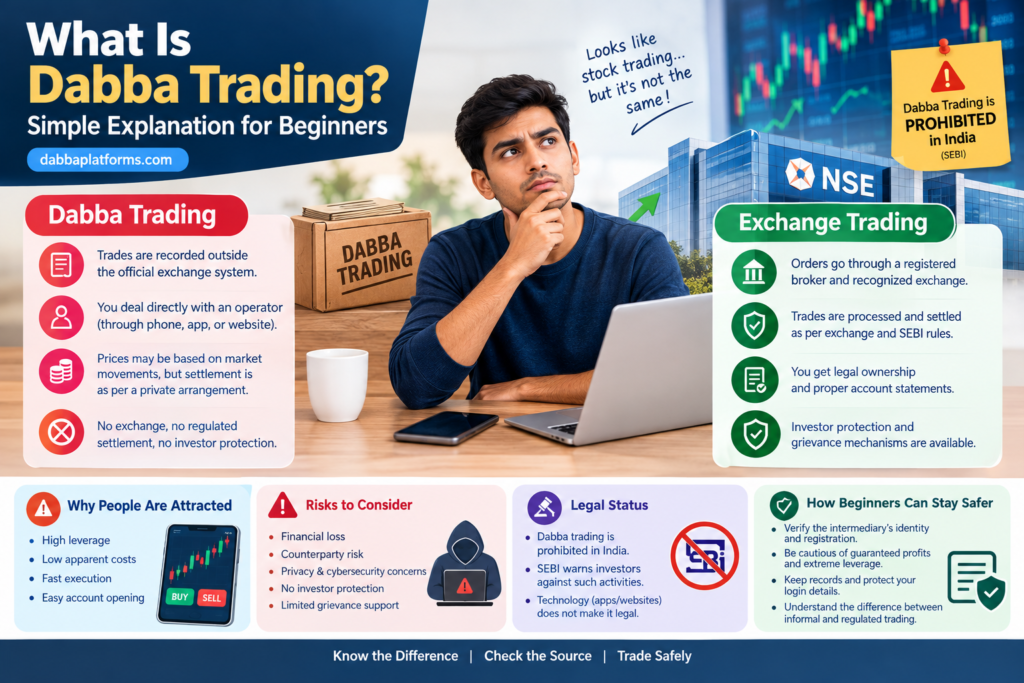
People searching for trading opportunities in India may come across the term “dabba trading.” The phrase can sound similar to ordinary stock trading, but the underlying arrangement is different. Understanding the distinction is important because dabba trading is not the same as buying and selling securities through a recognized stock exchange and regulated intermediary.
In simple terms, dabba trading refers to an informal arrangement in which trades are recorded outside the official exchange and settlement system. The customer may receive prices based on market movements, but the transaction itself is not necessarily executed through the recognized exchange infrastructure. The operator and customer effectively settle the outcome according to their private arrangement.
How Dabba Trading Works
In a typical dabba arrangement, a person places a buy or sell instruction with an operator. Instead of the order being routed through a recognized exchange, the operator records it in an internal system or ledger.
Suppose a person takes a position based on the price of a listed stock. If the market price later moves in the expected direction, the operator may calculate a gain according to the agreed terms. If the price moves against the position, the customer may be asked to pay the resulting loss.
The key difference is that the trade is not being handled in the same regulated manner as an exchange transaction. The apparent market exposure can therefore be different from actual ownership or exchange-traded settlement.
Why It Is Called “Dabba Trading”
The word “dabba” literally refers to a box or container, and the term is commonly used to describe a parallel or unofficial record of transactions. Historically, the concept was associated with maintaining trades outside the official exchange books.
Modern versions may use phones, messaging applications, websites, or software interfaces, but changing the technology does not change the underlying nature of an arrangement if trades remain outside the recognized market system.
Dabba Trading vs Exchange Trading
In conventional Exchange-Based Trading, orders are placed through a registered intermediary and processed through established market infrastructure. Trades are recorded and settled according to exchange and regulatory rules.
With dabba trading, the operator may simply mirror market prices while keeping the customer’s position in an internal record. The customer may not have the same rights, protections, or ownership status associated with a properly executed exchange transaction.
This distinction matters even if the price displayed by the operator appears identical to a public market price.
Why People May Be Attracted to It
Informal operators may advertise high leverage, low apparent costs, fast execution, or simple account opening. These features can appear attractive to someone who wants to take large positions with relatively little money.
However, high exposure also means that a small market movement can create a large gain or loss relative to the amount deposited. Claims about unusually high leverage should therefore be examined carefully.
Legal Status and Investor Protection
Dabba trading is prohibited in India. The Securities and Exchange Board of India and investor-education materials have repeatedly warned investors about unauthorized or illegal trading activities.
The legal issue is not simply whether a person is looking at a listed stock. The concern is that transactions are being carried out outside the recognized exchange mechanism and without the regulatory framework that applies to authorized market activity.
A user should not assume that an online website or mobile application changes this position. The technology used to record a transaction does not automatically make an informal trading arrangement legitimate.
Risks Beyond Market Losses
Financial loss is only one risk. A customer may also face counterparty risk. In an informal arrangement, the operator is the party recording the trade and calculating the settlement. If the operator refuses to pay, disappears, blocks access, or disputes a transaction, the customer may have limited practical protection.
There can also be privacy and cybersecurity concerns. Users may be asked to provide identity documents, banking details, or personal information to an unregulated operator.
Another risk is the absence of normal investor protections and grievance mechanisms associated with regulated intermediaries.
How Beginners Can Stay Safer
A beginner should first understand the difference between an exchange, a broker, and an informal operator. Before depositing money, verify the identity and registration status of the intermediary through official sources.
Do not rely only on advertisements, testimonials, social-media posts, or promises of extraordinary returns. Claims of guaranteed profits or extremely high leverage are warning signs that deserve careful scrutiny.
Keep records of transactions and avoid sharing passwords or one-time authentication codes. Most importantly, understand the legal and financial structure of the service before committing funds.
Conclusion
Dabba trading is an informal form of trading in which transactions are handled outside the recognized exchange and settlement system. It may resemble ordinary stock trading because it can reference publicly quoted prices, but the legal and operational structure is fundamentally different.
For beginners, the central lesson is simple: a trading app, website, or price screen does not by itself establish that a service is authorized. Verify the intermediary, understand how orders are executed and settled, and consider the protections available before participating in any financial market.
For anyone searching for dabba trading or Dabba Trading in India, the most important point is to understand the difference between an informal arrangement and regulated exchange-based trading. A professional-looking website or app does not by itself establish authorization or investor protection.